Did Hurricane Wilma have 209 mph sustained winds?
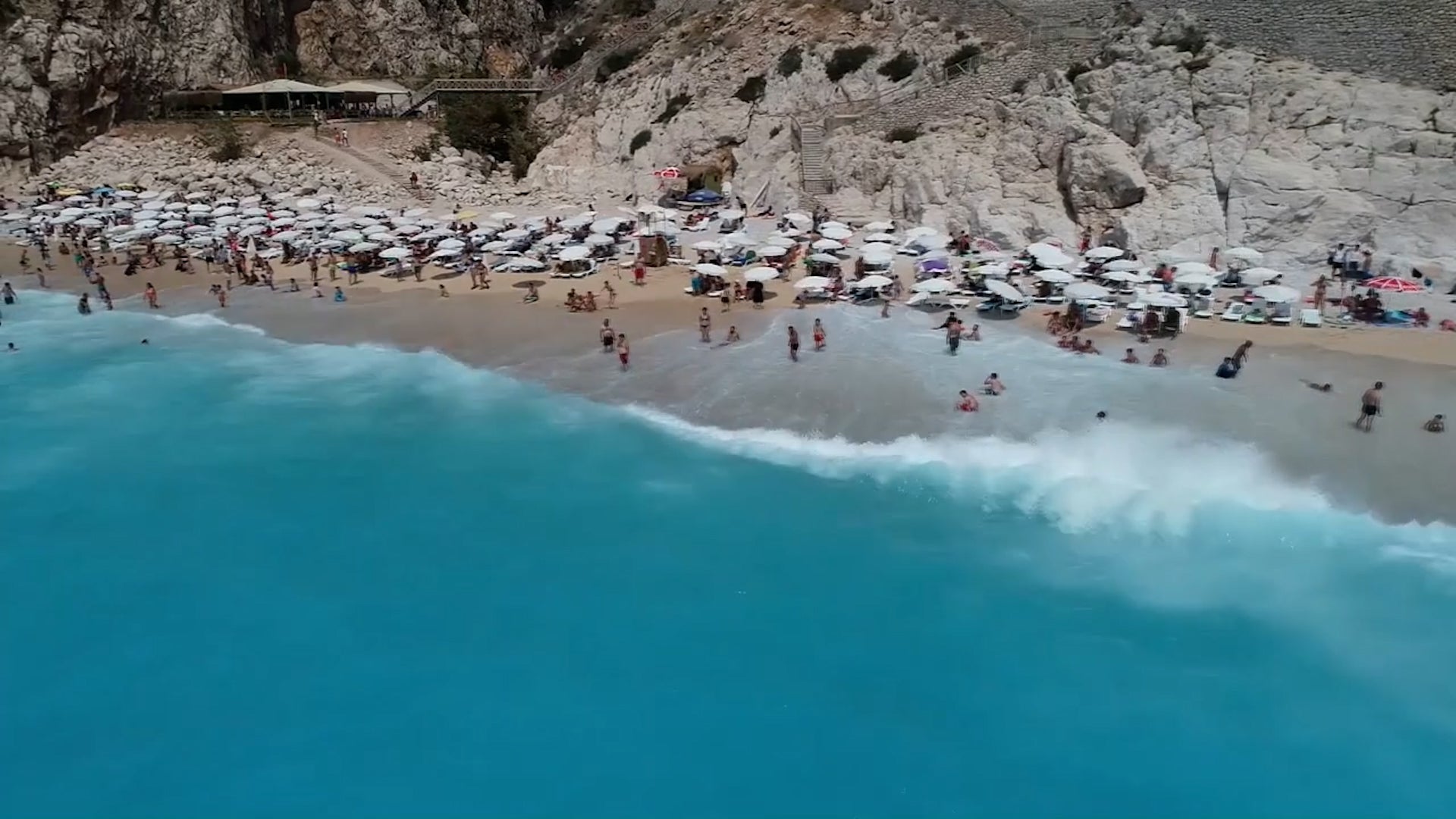
At last week's 30th Conference on Hurricanes and Tropical Meteorology of the American Meteorological Society, Dr. Eric Uhlhorn of NOAA's Hurricane Research Division presented a poster that looked at the relationship between surface winds measured by the SFMR instrument and flight-level winds in two Category 5 storms. Hurricane Hunter flights done into Category 5 Supertyphoon Megi (17 October 2010) and Category 5 Hurricane Felix (03 September 2007) found that the surface winds measured by SFMR were greater than those measured at flight level (10,000 feet.) Usually, surface winds in a hurricane are 10 - 15% less than at 10,000 feet, but he showed that in super-intense Category 5 storms with small eyes, the dynamics of these situations may generate surface winds that are as strong or stronger than those found at 10,000 feet. He extrapolated this statistical relationship (using the inertial stability measured at flight level) to Hurricane Wilma of 2005, which was the strongest hurricane on record (882 mb), but was not observed by the SFMR. He estimated that the maximum wind averaged around the eyewall in Wilma at peak intensity could have been 209 mph, plus or minus 20 mph--so conceivably as high as 229 mph, with gusts to 270 mph. Yowza. That's well in excess of the 200 mph minimum wind speed a top end EF-5 tornado has. The Joplin, Missouri EF-5 tornado of May 22, 2011 had winds estimated at 225 - 250 mph. That tornado ripped pavement from the ground, leveled buildings to the concrete slabs they were built on, and killed 161 people. It's not a pretty thought to consider what Wilma would have done to Cancun, Key West, or Fort Myers had the hurricane hit with sustained winds of what the Joplin tornado had.

Figure 1. Hurricane Wilma's pinhole eye as seen at 8:22 a.m. CDT Wednesday, Oct. 19, 2005, by the crew aboard NASA's international space station as the complex flew 222 miles above the storm. At the time, Wilma was the strongest Atlantic hurricane in history, with a central pressure of 882 mb and sustained surface winds estimated at 185 mph. The storm was located in the Caribbean Sea, 340 miles southeast of Cozumel, Mexico. Image source: NASA's Space Photo Gallery.

Figure 2. Damage in Joplin, Missouri after the EF-5 tornado of May 22, 2011. Image credit: wunderphotographer thebige.
Official all-time strongest winds in an Atlantic hurricane: 190 mph
The official record for strongest winds in an Atlantic hurricane is 190 mph, for Hurricane Allen of 1980 as it was entering the Gulf of Mexico, and for Hurricane Camille of 1969, as it was making landfall in Pass Christian, Mississippi. In Dr. Bob Sheets' and Jack Williams' book, Hurricane Watch, they recount the Hurricane Hunters flight into Camile as the hurricane reached peak intensity: On Sunday afternoon, August 17, and Air Force C-130 piloted by Marvin Little penetrated Camille's eye and measured a pressure of 26.62 inches of mercury. "Just as we were nearing the eyewall cloud we suddenly broke into a clear area and could see the sea surface below," the copilot, Robert Lee Clark, wrote in 1982. "What a sight! Although everyone on the crew was experienced except me, no one had seen the wind whip the sea like that before...Instead of the green and white splotches normally found in a storm, the sea surface was in deep furrows running along the wind direction....The velocity was beyond the descriptions used in our training and far beyond anything we had ever seen." So, the 190 mph winds of Camille were an estimate that was off the scale from anything that had ever been observed in the past. The books that the Hurricane Hunters carried, filled with photos of the sea state at various wind speeds, only goes up to 150 mph (Figure 2). I still used this book to estimate surface winds when I flew with the Hurricane Hunters in the late 1980s, and the books are still carried on the planes today. In the two Category 5 hurricanes I flew into, Hugo and Gilbert, I never observed the furrowing effect referred to above. Gilbert had surface winds estimated at 175 mph based on what we measured at flight level, so I believe the 190 mph wind estimate in Camille may be reasonable.

Figure 3. Appearance of the sea surface in winds of 130 knots (150 mph). Image credit: Wind Estimations from Aerial Observations of Sea Conditions (1954), by Charlie Neumann.

Figure 4. Radar image of Hurricane Camille taken at 22:15 UTC August 17, 1969, a few hours before landfall in Mississippi. At the time, Camille had the highest sustained winds of any Atlantic hurricane in history--190 mph.
The infamous hurricane hunter flight into Wilma during its rapid intensification
While I was at last week's conference, I had a conversation with Rich Henning, a flight meteorologist for NOAA's Hurricane Hunters, who served for many years as a Air Reconnaissance Weather Officer (ARWO) for the Air Force Hurricane Hunters. Rich told me the story of the Air Force Hurricane Hunter mission into Hurricane Wilma in the early morning hours of October 19, 2005, as Wilma entered its explosive deepening phase. The previous airplane, which had departed Category 1 Wilma six hours previously, flew through Wilma at an altitude of 5,000 feet. They measured a central pressure of 954 mb when they departed the eye at 23:10 UTC. The crew of the new plane assumed that the hurricane, though intensifying, was probably not a major hurricane, and decided that they would also go in at 5,000 feet. Winds outside the eyewall were less than hurricane force, so this seemed like a reasonable assumption. Once the airplane hit the eyewall, they realized their mistake. Flight level winds quickly rose to 186 mph, far in excess of Category 5 strength, and severe turbulence rocked the aircraft. The aircraft was keeping a constant pressure altitude to maintain their height above the ocean during the penetration, but the area of low pressure at Wilma's center was so intense that the airplane descended at over 1,000 feet per minute during the penetration in order to maintain a constant pressure altitude. By they time they punched into the incredibly tiny 4-mile wide eye, which had a central pressure of just 901 mb at 04:32 UTC, the plane was at a dangerously low altitude of 1,500 feet--not a good idea in a Category 5 hurricane. The pilot ordered an immediate climb, and the plane exited the other side of Wilma's eyewall at an altitude of 10,000 feet. They maintained this altitude for the remainder of the flight. During their next pass through the eye at 06:11 UTC, the diameter of the eye had shrunk to an incredibly tiny two miles--the smallest hurricane eye ever measured. During their third and final pass through the eye at 0801 UTC, a dropsonde found a central pressure of 882 mb--the lowest pressure ever observed in an Atlantic hurricane. In the span of just 24 hours, Wilma had intensified from a 70 mph tropical storm to a 175 mph category 5 hurricane--an unprecedented event for an Atlantic hurricane. Since the pressure was still falling, it is likely that Wilma became even stronger after the mission departed.
I'll have a new post by Tuesday at the latest.
Jeff Masters
Reader Comments
Page: 1 | 2 | 3 | 4 | 5 | 6 | 7 | 8 | 9 | 10 | 11 | 12 | 13 | 14 | 15 | 16 | 17 | 18 | 19 | 20 | 21 | 22 | 23 | 24 | 25 | 26 | 27 | 28 | 29 | 30 | 31 | 32 | 33 | 34 | 35 | 36 | 37 | 38 | 39 — Blog Index
The surface low is dependent on the sharp upper trough directly above it providing cold air aloft, divergence, and low wind shear, but this trough will be flattening out within 24 hours and losing its currently favorable configuration.
Furthermore, the upper trough will be lifting slowly northeast, but the high pressure area over the SE U.S. will be dragging the surface low westward or northwestward, stripping it out from underneath the upper trough. We see this all the time with early-season subtropical disturbances, where the surface low gets ripped out and a new one has to form. Here, there is likely not enough time for a closed circulation to form before conditions deteriorate for it.
This will still be a heavy rain event for Florida and the Bahamas of tropical origin.
Can someone that knows where to go and get this type of information find it and see what happened?
I was still in Memphis getting ready to move down here with the kids and "x" was already in Miami working..
It was on the news because it was a record breaking April rain...
Does anyone know about this event? was it similar to what we are getting now???
Yes, it made a big difference here.
Oh, now you show up! Where've you been? We're getting pounded down here.
yeah, that's what i said,,, it can be used as a guide
Yes, you can see the difference in surge between the two hurricanes
NATIONAL WEATHER SERVICE TAMPA BAY AREA - RUSKIN FL
1222 PM EDT SUN APR 29 2012
FLZ062-065-GMZ876-291730-
CHARLOTTE-LEE-BONITA BEACH TO ENGLEWOOD OUT 20 TO 60 NM-
1222 PM EDT SUN APR 29 2012
.NOW...
RADAR INDICATED THAT SHOWERS AND ISOLATED THUNDERSTORMS THAT HAD
REMAINED MAINLY OVER THE SOUTH TIP OF FLORIDA WERE MOVING WEST AT
10 TO 15 MPH AND WILL BE AFFECTING EASTERN CHARLOTTE AND LEE
COUNTIES OVER THE NEXT SEVERAL HOURS. EXPECT PERIODS OF HEAVY
RAINFALL...GUSTY WINDS...AND OCCASIONAL LIGHTNING WITH THE
STRONGER STORMS.
$$
RHEA
RE:#919
Hey Eugene...
Just a friendly reminder,
I hope your not really laughing at Florida folks here...some are the best contributers and their content is great..Neaopolitin,Grothar,kwgirl,seflgamma, to name a few..
Come crunch time they've posted here on WU up until the power goes out..so don't be so harsh on us and we won't pre-judge you. :)
I mean no harm by saying this at all.
Thanks
I just got out of bed lol.
I think a similar effect was seen with Ike in '08. ['09?]. The winds decreased as the storm approached, but the surge was sustained by the size of the storm.
I like the move the NHC made to designate SSHS as a wind scale, but I still think we need to stipulate what a cat 1 - 5 surge is like and specify whether the expected surge is likely to be the same category as the winds.
Why is it that hardly anybody lives on Andros? I found it a nice island.
As soon as something interesting happens, or as soon as I think something interesting will happen :)
Link
NOOOOO another 80% chance of rain tomorrow!!!
Levi, glad you showed up.. we've been covering for you.. yesterday I said you were really busy with school work when someone ask where you have been!
You're a nice guy!
sort of looks like that on link 969 MAweatherboy..
Agreed Baha and surge is usually the most deadly and destructive part of an hurricane
And it's the largest island in the Bahamas
2. Hurricanes. Aside from the east coast, most of Andros is swampy bogland similar to the Everglades in numerous ways. I'd hate to see it drained off to accommodate pple.
3. Jobs. Gotta work to live, and right now Andros is not a high employment area.
I lived in Andros for a few years some time ago, and I really enjoyed living there. Now that they have internet access, I wouldn't mind moving back....
Our first crisis of the season and you're sleeping?? Our winds could get as high as 20mph today. No, seriously, we have been getting tremendous amounts of rain. Having lived here on and off since 1947, I've seen these before. We had the big Fort Lauderdale Air Show this weekend and it has been cancelled. It was in the planning for months.
Why not, they did it here in South Florida. Maybe that is why I liked it so much. If reminded me of Florida way back when.
Youre showingg ur age gro:)
That was done to Portmore, St Catherine, Jamaica and the population is now over 200000
Read more here: http://www.miamiherald.com/2012/04/29/2774204/rain -plays-havoc-on-interstate.html#storylink=cpy
Think it was this one. Set a record for 24 hr rainfall, 16.39 inches.
Thanks for that.
I normally keep my mouth shut.
I rarely have much to contribute,but WU is a place I can go to for what I consider the most current and best info.
When this blog is civil it is a great place to exchange ideas and viewpoints,weather-wise.
I had to post that response. :)
What's up Levi...what's your prediction for the hurricane season?
Yeah, but I didn't say that was the year I retired.
LOL
Can you tell me about the dinosaurs then???
Well by Wednesday most forecast models take this well west of South Florida(which is a good thing from what I'm hearing down there).
thanks, I've been looking ever since I posted that but could not find anything. I will take a look at that line!
Looks like Florida will be dealing with the have's and have not's in the rain department this week as a building ridge will suppress any deep layer moisture from entering Central Florida! Only slight chances for rain are possibly in store for Orlando over the coming week.
many WU friends are on FB and we are talking weather... but nothing as good as info here.
I put this info on my FB wall and gave you credit for finding it.. of course I used your "handle" not name.
Thank you..
Why on Earth did you install that pond on the side of your house?
And hopefully this moisture will help fuel the rainy season storms when the pattern sets up in a few weeks :O)
What's up gamma...are you enjoying your weekend?
Viewing: 951 - 1001
Page: 1 | 2 | 3 | 4 | 5 | 6 | 7 | 8 | 9 | 10 | 11 | 12 | 13 | 14 | 15 | 16 | 17 | 18 | 19 | 20 | 21 | 22 | 23 | 24 | 25 | 26 | 27 | 28 | 29 | 30 | 31 | 32 | 33 | 34 | 35 | 36 | 37 | 38 | 39 — Blog Index